When people enter a citizens' assembly or public consultation, they do not arrive as blank slates. They bring lived experience, personal priorities, frustrations, hopes, and assumptions about what should happen next.
That is not a problem. In fact, it is the point of democratic deliberation.
But it does create a challenge. If people are asked to make decisions together on complex public issues, how do we help them move beyond the question, "What do I want?" and towards a wider question: "What does this community need?"
One way to do this is through a classic idea from political philosophy, reimagined through digital game design: John Rawls' "veil of ignorance".
At PSi, we used this concept as part of our serious game development work on COCTEAU. Commissioned by the Centre for European Policy Studies, the game was designed to help citizens' assembly participants rehearse empathy, fairness, and collective decision-making before deliberation begins.
What Is The Veil Of Ignorance?
The veil of ignorance is a thought experiment developed by the philosopher John Rawls. It asks people to imagine designing the rules of a society without knowing what position they will hold within it.
You might be wealthy or poor. Powerful or overlooked. Healthy or unwell. Well connected or isolated. You do not know.
Rawls' argument is that fairer rules are more likely to emerge when people cannot design those rules only to benefit themselves.
For public deliberation, this idea is powerful because it shifts attention away from individual advantage and towards collective fairness. It encourages people to think about systems, not only preferences.
Turning A Philosophical Idea Into A Digital Experience
In the COCTEAU game, we translated the veil of ignorance into a practical digital mechanic.
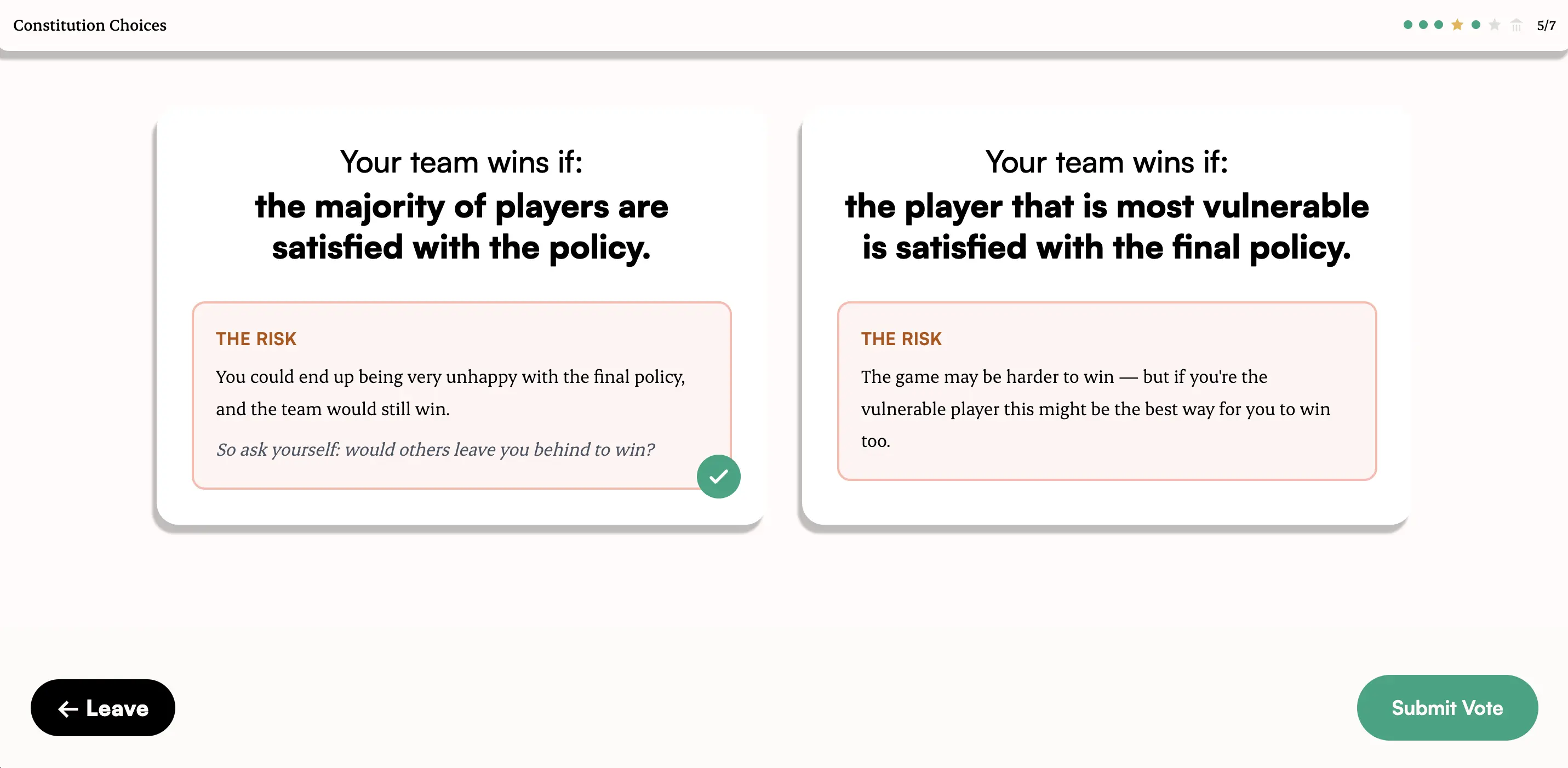
At the start of the game, participants enter a small-group simulation. They are introduced to a public policy challenge, but they do not yet know who they will be in that scenario. Their role, stakeholder position, level of influence, and constraints are hidden from them.
Before any roles are revealed, the group must agree the rules of the game.
They may need to decide how a decision-maker should be chosen. Should that person be elected by the group, selected against agreed criteria, or chosen at random?
They may need to decide what principle should guide the distribution of limited resources. Should the group prioritise those facing the greatest structural disadvantage, or should they focus on overall efficiency?
They may also need to decide how speaking time should be managed. Should everyone have equal time, or should the process recognise that some participants may need more support to be heard?
At this stage, no one knows whether they will later become a powerful stakeholder, a constrained participant, or someone whose needs are difficult to make visible.
That uncertainty matters.
It encourages players to design rules that are not simply good for themselves, but good enough for anyone.
Creating Productive Discomfort
The purpose of the mechanic is not to make the game abstract or philosophical. It is to create a useful kind of discomfort.
When players realise that the rules they choose may later disadvantage them, their perspective begins to shift. They have to think carefully about fairness before they know what fairness will mean for them personally.
Once the rules are agreed, the veil is lifted. Roles are assigned. Players discover who they are, what they need, how much influence they have, and what constraints they must work within.
Often, they then have to live with the consequences of the rules they helped create.
This is where the learning happens. Participants are not only debating fairness as an idea. They are experiencing how rules, roles, time limits, information, and power shape whose voice is heard.
Why This Matters For Citizens' Assemblies
Citizens' assemblies depend on more than good information. They also depend on trust, perspective-taking, and the ability to listen across difference.
A well-designed serious game can help prepare people for that work.
By simulating structural inequality, limited resources, and competing public needs, the COCTEAU game gives participants a chance to practise democratic behaviour before entering a live deliberative process.
They can test what it feels like to advocate for a position. They can experience what it means to have limited influence. They can see how easily a process can feel fair to one person and unfair to another.
Most importantly, they can begin to understand that public decision-making is not only about choosing the right outcome. It is also about designing a process that people can recognise as legitimate.
From Simulation To Real-World Deliberation
The value of this approach is strongest when the game is connected to real deliberative work.
A simulation can open up perspective. A live public engagement process can then use that readiness to support better discussion, clearer trade-offs, and more thoughtful collective decisions.
This is where COCTEAU connects with PSi's wider work in collective intelligence. The same principles that shape the game also shape our platform: structured participation, accessible dialogue, multilingual support, distributed decision-making, and analysis that helps public bodies understand what people think, discuss, and support.
The game is not a replacement for public deliberation.
It is a rehearsal space for it.
By giving participants a practical experience of fairness, constraint, and empathy before the formal process begins, serious games can help create the conditions for more constructive democratic decision-making.